Starmind explained: the FCC's million-satellite SpaceX order
What the FCC's Space Bureau authorised for up to one million SpaceX Starmind satellites, the deadlines from 2033 to 2040, and what it means in Australia.
By GadgetRelay desk10 min read
On this page
On 25 November 2026 the FCC's Space Bureau authorised SpaceX to operate up to 1,000,000 Starmind satellites as data centres in low Earth orbit. The order is granted in part and deferred in part, with conditions. The first deadline is years away. One satellite must be in its assigned orbit and operating by 25 November 2033, or the authorisation becomes null and void.
Starmind is a proposal to do AI computing in orbit and send the results back through Starlink's lasers. It is a different system from the Starlink broadband service Australians can already buy. This explainer follows the Space Bureau's order, DA 26-1273, and SpaceX's application.
What Starmind is
SpaceX filed on 30 January 2026 for authority to launch and operate up to one million satellites with computing capacity for AI models and the applications that use them. The Bureau's grant names the system the SpaceX Orbital Data Center system, Starmind. The file is SAT-LOA-20260108-00016, call sign S00798.
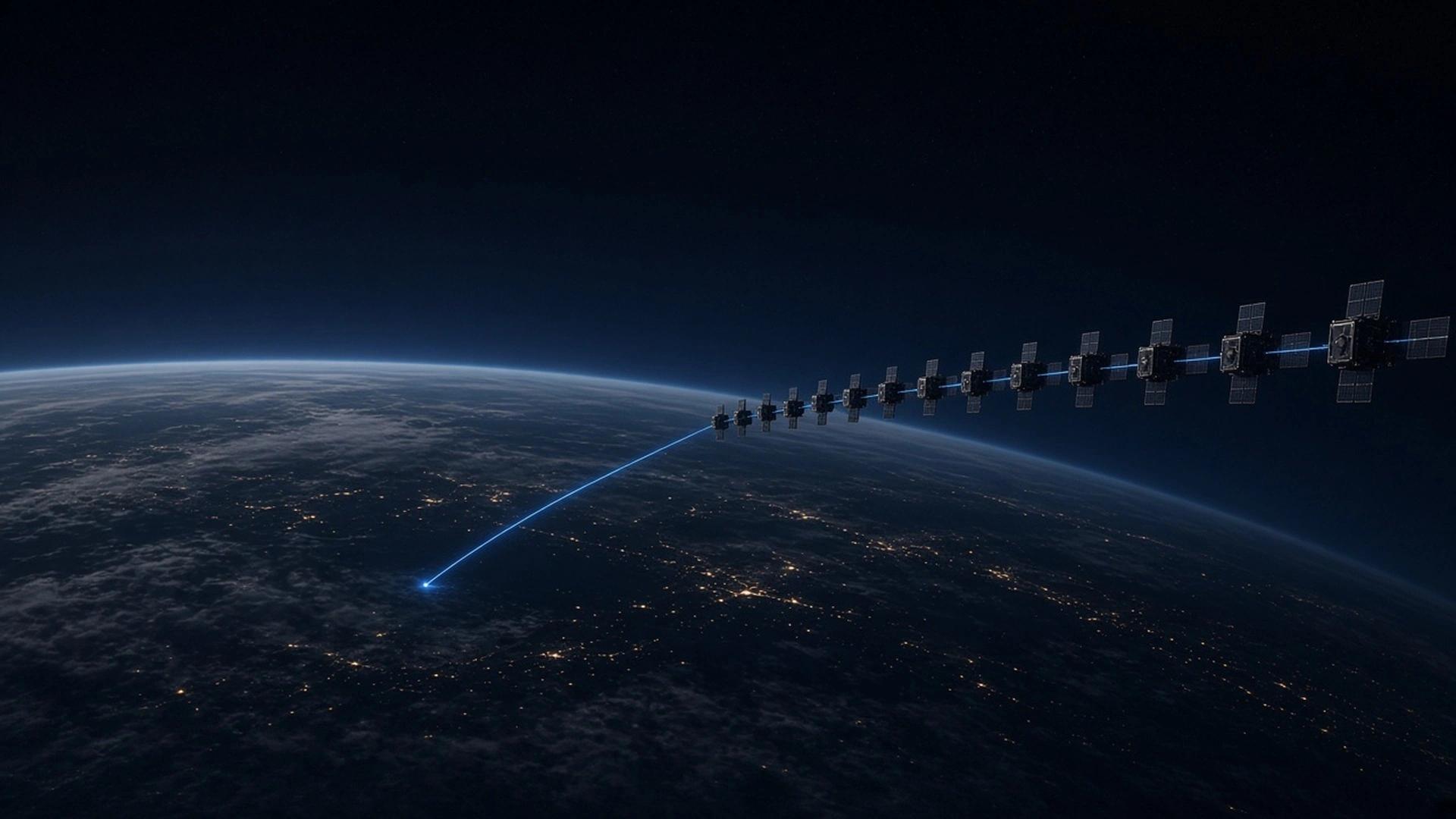
In its application narrative, SpaceX said the satellites would rely almost entirely on optical links. Those links would route traffic inside the network and to Starlink satellites, "via its high capacity (petabit) and high reliability laser mesh," and Starlink would carry the traffic on to authorised ground stations. Radio gear would be there for backup telemetry, tracking and command, particularly early in a mission and after it ends, and only if the lasers fail.
The computing people use today already sits in ordinary data centres on the ground. Gemini 4 Neon is one model Google offers on paid plans in Australia. Starmind, if it is built, would be more hardware in orbit. It does not change how those plans work.
What the Space Bureau granted
The decision is a memorandum opinion, order and authorisation, adopted and released on 25 November 2026. Courtney Reinhard, Chief of the Space Bureau, signed it under delegated authority. The ordering clause grants the application in part and defers it in part.
The radio grant is narrow. It authorises backup and emergency telemetry, tracking and command in two Ka-band ranges: 18.8–19.3 GHz from the satellites to Earth, and 28.6–29.1 GHz from Earth to the satellites. SpaceX must use those frequencies on an unprotected basis. It must not cause harmful interference, and it cannot claim protection from other operators. If it receives a documented report of harmful interference, it must stop the operations that caused it until the problem is resolved, and tell the Commission in writing.
The Earth-to-space band also has to protect current and future US federal systems. Before SpaceX uses the space-to-Earth band, where federal services are primary, it must finish coordination with the relevant federal agencies. A Starmind satellite still needs a separate earth-station authorisation before it talks to a gateway on the ground.
The Bureau waived the usual processing-round rules and the surety-bond rule for this backup radio use. The replacement guardrail is a set of deployment deadlines. Miss one, and the authorisation becomes null and void. SpaceX has 30 days from release to decline the grant as conditioned. If it does not respond, the order treats that silence as acceptance.
Chairman Brendan Carr did not sign the order. He posted on X the same day that, "in a historic first," the FCC had approved SpaceX's request for 1 million satellites, which he called orbital compute modules, "to create data centers in space." He wrote: "The Starmind & competitor constellations will use solar power to extend America's lead in Super Intelligence." Elon Musk replied under that post: "Much appreciated. This will be a great asset to America and the world."
The Bureau's own public-interest line is plainer. It said the grant lets SpaceX "pioneer emergent technology that advances American leadership in space and artificial intelligence."
Orbits from 500 km to 1,002 km
SpaceX's January application described orbital shells between 500 km and 2,000 km. The grant, citing a SpaceX letter of 29 May 2026, authorises shells from 500 km to 1,002 km. Each shell spans 50 km. The inclinations are 30 degrees and sun-synchronous. These are the nominal orbits in the order:
| Altitude | Inclination |
|---|---|
| 550–568 km | 26–32 degrees |
| 565–585 km | 97.7 degrees |
| 686–718 km | 30 degrees |
| 707–744 km | 97.2 degrees |
| 946–978 km | 30 degrees |
| 967–1,002 km | 99.4 degrees |
Deadlines from 2033 to 2040
The order sets four deadlines. At each one the satellites have to be in their assigned orbits and operating under the authorisation. The last deadline also says the remaining satellites must be launched.
SpaceX must have one satellite in its assigned orbit and operating by 25 November 2033, 10 per cent of the 1,000,000 maximum (100,000 satellites) by 25 November 2035, 50 per cent (500,000 satellites) by 25 November 2038, and the remaining satellites needed to complete the authorised constellation launched, in orbit and operating by 25 November 2040.
| What the order requires | Deadline |
|---|---|
| One satellite in its assigned orbit and operating | 25 November 2033 |
| 10 per cent of the maximum, 100,000 satellites | 25 November 2035 |
| 50 per cent of the maximum, 500,000 satellites | 25 November 2038 |
| The remaining satellites, completing the authorised constellation | 25 November 2040 |
The licence term is 15 years, and it begins at 3 a.m. Eastern Standard Time on the day SpaceX certifies to the Commission that the first Starmind satellite has been successfully placed into orbit and that its operations fully conform to the conditions. The order uses the abbreviation EST for that start time. SpaceX must file the certification within five business days of putting the first satellite into operation.
Seven years sit between this order and the date the first satellite must be operating. The Bureau also declined to judge whether the business will work. It set aside comments that the technology might not be practical, or might not be needed, as outside the job of licensing radio.
Power and cooling, in SpaceX's words
The case for putting the computers in orbit is SpaceX's, made in the 30 January narrative. The February public notice that accepted the application for comment quotes the company's framing. SpaceX called the system the "first step towards becoming a Kardashev II-level civilization" and "one that can harness the Sun's full power." The notice describes a Type II civilisation, on the Kardashev scale, as one that can harness all the energy output of its host star.
On power, SpaceX wrote: "By directly harnessing near-constant solar power with little operating or maintenance costs, these satellites will achieve transformative cost and energy efficiency while significantly reducing the environmental impact associated with terrestrial data centers."
It also wrote that high-altitude sun-synchronous orbits can be in sunlight "up to more than 99% of the time," which would reduce the need to rely on batteries and on power cycling. That claim sits in a passage about a system stretching up to 2,000 km. The grant stops at 1,002 km. The 99 per cent figure is SpaceX's description of high-altitude sun-synchronous orbits. It is not a figure the order measured.
On heat, SpaceX pointed to "cooling through radiative heat dissipation," and wrote that radiative cooling "enables passive heat dissipation into the vacuum of space." It contrasted that with ground data centres whose cooling, it said, uses "billions of gallons of water annually." The water comparison is SpaceX's. The order does not adopt it.
SpaceX also rested the scale of the project on Starship. It wrote that fully reusable vehicles such as Starship could, "when launching at rate," deploy "millions of tons" of mass to orbit in a year. The order does not set a launch rate, and it does not licence Starship. The Bureau said review of the environmental effects of rocket launches sits with the Federal Aviation Administration.
Debris and astronomy
Viasat and Kuiper Systems, the Amazon Leo satellite unit, petitioned the Bureau to deny the application, as did the American Astronomical Society. The concerns on debris included collision risk, disposal failures and casualty risk. The Bureau denied all three petitions.
For satellites that will operate below 600 km, the Bureau found that SpaceX's orbital-debris plan meets the Commission's rules. The order records SpaceX's commitments to test satellites at lower altitudes before raising them, to deorbit operational satellites in a controlled way, to keep collision avoidance available until just before re-entry, to steer re-entries over the ocean, and to design each satellite so that it fully burns up.
The Bureau deferred SpaceX's request to dispose of satellites operating above 600 km into other orbits around Earth, or into orbit around the Sun, instead of by atmospheric re-entry, because SpaceX had not provided sufficient information. The rule SpaceX asked to waive says that a satellite ending its mission below 2,000 km is successfully disposed of only if it re-enters the atmosphere as soon as practicable, and no later than five years after the mission ends. SpaceX had asked for "flexibility to dispose satellites operating above 600 km altitude into Earth disposal orbits or heliocentric orbits." A heliocentric orbit is an orbit around the Sun. Before SpaceX flies any Starmind satellite that will not re-enter, it must file a modification and justify the waiver.
The order also requires a modification that contains the final debris plan, covering every element of the rules, before SpaceX deploys any Starmind satellite that will operate above 600 km.
Twice a year, on 1 January and 1 July, SpaceX must report predicted close approaches, satellites removed from service, re-entries, how many satellites are deployed and in which orbits, and how many used the Ka-band backup.
On the wider environment, the Bureau said it will not require a further review under the US National Environmental Policy Act. It relied on an October 2026 Commission decision that treated licensed activity in space as outside that Act. It said concerns about pollution from rocket launches are outside the FCC's purview. It described concerns about the atmosphere from satellites burning up on re-entry as "speculative and not supported in the record." That is a conclusion about the evidence filed in this proceeding.
The American Astronomical Society argued that waste heat from the satellites could raise the infrared background of the sky and threaten research. The Bureau said impacts that do not come from the radio operations fall outside this licence, and it added no condition aimed at that heat. It treated optical-astronomy concerns as met by SpaceX's commitment to coordinate with the US National Science Foundation, and it noted that the Commission's rules do not protect optical astronomy.
The Square Kilometre Array Observatory filed comments on 5 March 2026. The Bureau described them as a worry that the satellites would reflect radio waves and interfere with other radio services. It was not persuaded. It said the comments were not specific to the radio operations SpaceX had proposed, and that they offered no technical support for interference from reflected waves. SKAO is the organisation building SKA-Low in Western Australia's Murchison shire, on the traditional lands of the Wajarri Yamaji. The FCC order does not name that telescope. The comment on the file is about radio reflections from the constellation.
Starlink, and what it means in Australia
Starlink is SpaceX's broadband constellation in low Earth orbit. On SpaceX's account, Starmind would use Starlink's laser mesh as the route from the orbital computers down to authorised ground stations. The Ka-band grant is the backup command link. The Bureau accepted SpaceX's point that an optical failure large enough to put all one million satellites on the radio at once is unlikely. If a Starmind satellite does need that radio, SpaceX has said it would talk to gateway stations already inside the coordinated footprint of the first- and second-generation Starlink systems.
Someone choosing an internet service in Australia is still choosing among Starlink, a fixed connection and mobile. Starlink in Australia goes through the plans Starlink listed for this country in November 2026, the dish and the sky view, and why the checkout is the price that counts. Built-in Starlink for more Teslas is a separate hope Musk has expressed, with no Australian date announced. That sits in Starlink in more Teslas by late 2027.
The Starmind order is a United States licence. It does not offer a Starmind service in Australia, and the Starlink plans already sold here are unchanged by it. No deployment deadline in the order falls before 25 November 2033. The order does not mention the Australian Communications and Media Authority. The Australian connection on the record is the SKAO comment described above.
If you are weighing Starlink broadband for an Australian address, Starmind is not an input to that choice. The button is a referral for Starlink. When Starlink applies the offer, a new signup gets a free month and GadgetRelay gets a free month. It does not lower the monthly plan price. Enter the service address and judge the checkout.
Questions readers ask
What is SpaceX Starmind?
Starmind is SpaceX's proposed constellation of up to one million satellites that would run as data centres in low Earth orbit, doing AI computing for use on the ground. SpaceX told the FCC the satellites would use solar power, shed heat into space, and send data by laser through the Starlink constellation to ground stations. Radio would be a backup for commands.
What did the FCC approve on 25 November 2026?
The FCC's Space Bureau granted SpaceX's application in part and deferred it in part, with conditions. The grant authorises up to 1,000,000 Starmind satellites. The radio rights are limited to backup and emergency tracking and command in two Ka-band ranges, with no protection from interference. The Bureau deferred SpaceX's request for a non-re-entry disposal method for satellites operating above 600 km.
When does the first Starmind satellite have to be operating?
The order requires one Starmind satellite in its assigned orbit and operating by 25 November 2033. SpaceX then has until 25 November 2035 for 10 per cent of the maximum, 25 November 2038 for 50 per cent, and 25 November 2040 to complete the authorised constellation. Missing a deadline makes the authorisation null and void. The order does not set a launch date before 2033.
Does the Starmind order change Starlink in Australia?
Starmind does not change Starlink plans in Australia. Starlink is a separate broadband service SpaceX already sells here, and the Starmind order is a United States licence for a computing constellation that has not been deployed. The price for an Australian address is still the one in Starlink's checkout after you enter the service address.
Related reading


Spot a stale price or a mistake? Email hello@gadgetrelay.com. Edited in Brisbane.